

dope
Prompt
 16:9
veo3
16:9
veo3
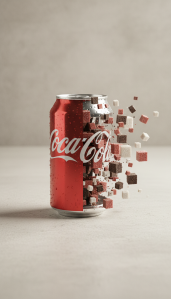
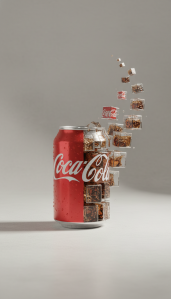
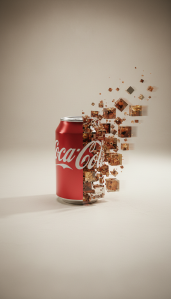
A high-resolution, photorealistic cinematic animation showcasing the decomposition and re-composition of a standard aluminum Coca-Cola can in a controlled studio environment. The entire sequence utilizes sophisticated fluid dynamics simulation and highly detailed texture mapping. SCENERY: The object rests centered on a seamless infinity cyclorama backdrop, rendered in a pale, warm taupe matte texture, establishing a sterile, high-end product presentation atmosphere. LIGHTING: Controlled, high-key lighting setup using a large cinematic softbox as the key light, positioned slightly above and to the left, creating a subtle, elongated shadow grounding the can. Strong, localized rim lighting emphasizes the curved edges and the hyper-realistic surface condensation, highlighting the microscopic water droplets glistening on the vibrant red polished aluminum. The atmosphere is crisp, cool, and hyper-detailed, maximizing specularity and subsurface scattering effects on the granular elements. TEXTURE: The left half of the can remains perfectly intact, covered in bead-like condensation, reflecting the soft studio light. The right half undergoes a complex disintegration process. PHASE ONE: INITIATION AND SUGAR FRAGMENTATION. The animation begins with a tight Medium Close-Up (MCU) of the intact, sweating can. A subtle, slow dolly zoom begins as a perfectly vertical fracture line appears. The right half instantly decomposes into thousands of precise, identical cubic fragments (approximately 1cm x 1cm x 1cm). These fragments are texturally varied: brilliant white granulated sugar cubes, dark crystalline brown sugar cubes, and cubes stained deep crimson, representing flavor concentrate. These sugar cubes immediately begin accelerating outwards in a controlled, non-chaotic vector flow, rising vertically and diverging laterally from the can’s axis in a highly stylized laminar flow pattern. PHASE TWO: LIQUID CUBE DISPERSAL. The motion transitions into the second form of fragmentation. The right half reconstitutes itself briefly, only to shatter again, this time yielding clear, square acrylic or glass containment boxes. Inside each cube is a perfectly contained volume of highly saturated, dark amber cola liquid. The internal fluid dynamics show subtle, realistic sloshing and movement within the transparent boxes as they ascend. A dynamic orbital tracking shot encircles the object at eye level, focusing sharply on the reflectivity of the glass cubes, catching the reflection of the surrounding studio environment. Look for internal details, such as microscopic bubbles within the simulated cola liquid and the slight prismatic distortion caused by the cubed geometry. PHASE THREE: RECONVERGENCE. The dispersed particles (sugar, liquid cubes, and a third wave of small, shattered crystalline powder fragments) reach their maximum point of dispersion, filling the frame in an aesthetically balanced composition adhering to the rule of thirds. Following a brief 500-millisecond pause at peak dispersion, the motion executes a dramatic, high-speed reverse simulation. All fragments rapidly accelerate inwards, converging with extreme precision back into the vertical seam. The motion blur should be intensely stylized during this convergence phase. FINAL SHOT: The two halves of the can perfectly weld back together, resulting in a single, unified, icy-cold, perfectly polished product beauty shot. The camera executes a slow, deliberate push-in (dolly move) toward the perfectly centered, static can, ending the sequence on a sharp focus of the iconic white logotype and the hyper-detailed condensation. Film grain subtle, aspect ratio cinematic, color grading high contrast, saturated reds. End frame frozen on the perfect can.
Image prompt:




 200 Tokens
 1,000 Points
 1,000 Smiles